


Meadhead's been around the block a time or two and this is your chance to tap into the vast knowledge that flows forth from the Meadhead brain. Meadhead knows a little about a lot and if Meadhead doesn't know the answer he will find out and present it in lovable Meadhead fashion.
Buckley wrote in to ask:
How many pieces of string does it take to reach the Moon?
I could take the easy way out and proclaim that it would only take one piece of string—it just needs to be really, really long.

But Meadhead wants to dig a little deeper into this mystery. The first place I turned to was the Google because it is the source of all knowledge worth knowing. Entering the search terms "moon" and "string" returned this image of some g-strings that illustrate little-to-no distance from their respective moons. But something tells me that's not quite the answer you were looking for.
Sifting through the the moon dust we find out that at different points in the moon's elliptical orbit it's distance from earth varies. At it's farthest point, called the Apogee the moon is 250,000 miles away and at it's closest point, the Perigee, it's 220,000 miles. Another factor complicating the equation is that the moon is moving away from the earth at 1.5 inches per year. So the string would need to be longer and longer as days go by.
To reach the moon, this piece of string would obviously have to overcome the gravitational pull of the earth and achieve an escape velocity of 6 miles per second or 34 times the speed of sound or 10 times the speed of a rifle bullet. No easy feat for a piece of string.

If you look into String theory, which is the concept that all matter and forces of the universe are made up of tiny vibrating strings, you find that the Theory of General Relativity and Quantum Mechanics unite into a Quantum Theory of Gravity and you end up being totally confused. Leave it to the kitties, they'll figure it out.
But back to the really long string thing. The next question is where would you find the really long piece of string.
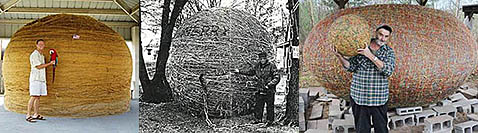
Well, as it turns out collecting big balls of string is a rather common pastime. I think if we combined all these big balls of string we just might achieve the proper length to reach the lunar surface, at which time we'd break out the huge measuring stick to give us our final answer.
So, Buckley, in the end I will leave this yarn for you to unravel. Thanks for asking!
Jami and Adam write in to say:
We were chatting with a fellow meadhead in tc [Traverse City] about the origin of ipa. We would love to find out the truth about this delicious style of beer.
Sincerely,
The newest Meadheads Jami and Adam
Hi Jami and Adam and welcome. We are always delighted to meet new meadheads.
Sounds like there was a friendly neighborhood-tavern-style disagreement about India Pale Ales and what they're all about. Here's some background.
Current IPAs are modeled after beer that was first shipped from Great Britain to India in the 1700s.
The first usage of the the term "India Pale Ale" comes from a Liverpool, England newspaper around 1835. It is a shorter version of "pales ales prepared for India," the literal term for any beer that was to be shipped to India.
Now you're probably asking, "What was so distinct about beer bound for India that it got its own designation?" The answer has to do with the lack of refrigeration and pasteurization back in the early 1800s.
IPAs are deliciously hoppy for more reasons than the desire to bitter up the beer.
Beer would spoil on the long journey to India so the brewers got inventive and started adding much larger quantities of hops to the beer. This had two benefits--hops happen to be naturally anti-microbial in that they deter spoilage and hops also aid in continued fermentation which makes for higher alcohol content and higher alcohol helps preserve.
The "pale" part of the name came from the tradition of using pale malts that were roasted in coke-fired ovens during the brewing process.
So there you have it. I hope this satisfactorily answers your question and deters any future squabbles. Now go get yourself something really hoppy and bring you taste buds to life.
Dear Meadhead, I really screwed up and I wondered if you can help. My wife found me looking at websites featuring women who were less than fully-clothed. The fact is I was only doing research for a psychology paper on the desensitization of stimuli upon repeated exposure... Anyhoo, needless to say, she blew her top and kicked me out the door saying she never wanted to see me again.
So I was wondering if there is any way I can go back in time, you know, with some sort of time machine so I could choose a different topic for my paper and thus avoid all the mess I've gotten myself into? Can you tell me how to make a time machine Meadhead?
Benny,
Jettsville, AL
Hi Benny, welcome and thanks for bringing up a subject that I've always been fascinated with—no, I'm not talking about internet porn, I'm talkin' Time Travel. If I had the chance I'd go back in time and thank the ancient Mesopotamians for being the first to ferment grains for intoxicating purposes.
Since I'm not much of an astro-physicist, to find the answers I went straight to the the smartest man in the world, Professor Stephen Hawking. According to Hawking there's good news and bad. The good news is there are three real possibilities for time travel, the bad news is it's really only possible to travel to the future and not the past.
Wormholes, where unfathomably small tunnels connect different spaces and times appear and disappear inside the quantum foam that makes up the nucleus of an atom. These could conceivably allow us to go backward in time if we could enlarge and retain the hole, but because of paradoxes such as you going back in time and killing your grandfather which would render you unable to have existed to have gone back in time and committed the dirty deed in the first place this method is not feasible.
What is feasible is to visit the future by orbiting a black hole and there just happens to be one at the center of the Milky way Galaxy. A black hole consists of an area where the energy of a million stars collapses to a single point, sucking everything near it in. Not even light can escape.
If you were in a spaceship that was powerful enough, orbiting a black hole works because time slows down near areas of intense gravitational pull. So after a five year trip to the black hole you'd come back to earth to find everyone having aged 10 years. Trick is getting there and not getting sucked in by the black hole.
The third method of time travel consists of traveling in a massive spaceship that nearly reaches the speed of 186,000 miles per second. This is the speed at which light travels and it is a law of nature that nothing can travel faster than the speed of light, So nature ensures that this speed is not reached by causing time to slow down. Upon returning after your long journey you'd find yourself to have aged much less than those back on earth .
So, yes, a time machine is possible but we don't quite have the resources to pull it off yet. You'll have to patch things up the old fashioned way—with candy and flowers.
For a more detailed explanation of these concepts read the short article by Stephen Hawking.